As I get older each day, I come to realise that there are so many things along life’s route that I could have explored further but just didn’t think it was important or mattered too much.
My father once asked his father how people came to live in Liap village. His father proceeded by calling the names of his forefathers up until 10 generations before him. The names, he could tell a few tale or two about them, the rest, just names and stories. Even people before the 10th generation was a blur. Assuming an average person lived for 60 years, the generations could have gone back as far as 600 years.
In trying to explain the journey, my grandfather recalls them as his father had told him before, told stories from generation to generation, without writing, but using words….words that sometimes sound so familiar yet so deep and distant. I would have loved to have created a time machine and go back along the generation lines and see what my forefathers were like. His stories of wars, head hunters, strong woman, great feasts, strange animals, beauty, hard work, mountains, migration, dying, love, trading, relatives and so many more. Stories of a time when fish were plentiful, wild pigs roamed ceaselessly and tattoos meant much more than marks on the face. His later stories of times during recent events as World War II, colonial rule, Makasol movement, and provincial governments are even fascinating Manus history.
I have asked myself often why these stories are even important at all. In one generation alone, we have jumped from strong traditional societies to embracing modernity. Yet, today, these stories of the fathers have become more valuable than gold because these stories put us in our place and acknowledge those who are around us. Unlike many nations where much history is written, ours is passed down orally.
These stories are the only things that tell us of who we are, why we came here, why we must do good to certain people or families, why things must be done in a certain way, why some things must never be spoken out loud, why hierarchy in families revolves around patriarchy….all these things that define who we are, why we do the things we do and what we stand for in our society. All these stories tie us to the land, sea and water- the only commodities that are worth fighting for. These stories are depositories of information that strengthen the pillars of the land tenure system that we possess in PNG.
When I was just a little boy, I remember that my grandfather was one of the very few in the village who had a blackboard in his house and sticks of chalk along sago leaf walls. My father continues this habit and so each year when I get to go back home for breaks from school, my father writes things on the blackboard…some things I don’t understand, some I don’t think important, some just names of people I haven’t met, maps of places. He tells me all this is will mean much more later….when you are task with a responsibility, when you are in trouble, when you need something, when you want to bless someone, to help you understand why someone will want to bless you…...These, he tells me, are the things I should pursue..the things I need to explore further....
And so, when one man dies, a thousand stories die with him. A vast library of knowledge that connects the dots along the generation lines is no more.
These stories may mean so much to someone yet may also mean so little to someone else. Even so, knowing where you have come from is as important as knowing where you are going to.
May 23, 2010

TELEK - West Papua, (merdeka mix)
Papua New Guinean singers, George Telek and Ngaiire Jospeh, sing a passionate song about the struggle of West Papuans for Independence from Indonesia.
Breast Cancer
Just found this interesting information...
A retrospective study of the Tumour Registry of PNG from 1958 to 1988, found the incidence of breast cancer in the country was 2.4 cases per 100,000 women, and in the same time period in NSW, Australia, the incidence rate was 64.9 cases per 100,000 women.
Now, according to the Integrated Regional Information Network (IRIN) , it reported that new information released by the PNG Department of Health, statistics show that from 2000-2004 the incidence of breast cancer in women in the 15-44 age group had risen from 8.49 per 100,000 in 2000 to 46.54 in 2004.
Why has the number of women who have breast cancer gone up in a relativity short time?
The IRIN news report on their webiste had this to say:
"A report by the PNG Health Department's technical adviser for lifestyle disease, Thomas Vinit, has revealed significant increases in cases of cancer, particularly among females. He said lifestyle habits were a major contributing factor, including smoking (lung, mouth, breast, cervical and uterine cancer), chewing betel nut (mouth cancer), not breast-feeding (breast cancer), illegal abortions (cervical and uterine cancer), multiple sexual partners (cervical cancer), obesity (breast, uterine and ovarian cancer) and heavy drinking (liver cancer)."
Sources
IRIN story: http://www.irinnews.org/Report.aspx?ReportId=81396
Breast cancer increases on Papua New Guinea, Bob Kuska
Journal of the National Cancer Institute; Jun 16, 1999; 91, 12; Academic Research Library pg. 994
May 19, 2010
Easily preventable yet so many still die...
PNG is truely in a sad state of affairs when it cannot even roll out a basic program that will save thousands of women from certain pain and death. More women will continue to die from Cervial Cancer because the PNG Government doesnt care enough to start a National Prevention Program.
According the Global Cancer Statistics in 2002, Cervical cancer ranks as the most common cancer (age-standardised incidence of 40.4 per 100,000) and is the leading cause of death (age-standardised mortality of 22.6 per 100,000) among women in PNG. It is truely sad that our women continue to die unnecessarily. Yet, the Government sees itself fit to buy a K100 million jet for 'ministerial tours'.

Find below is an excerpt taken from the study titled 'Human Papillomavirus and Cervical cancer in Australasia and Oceania: Risk Factors, Epidemiology and Prevention.' that was published in Vaccine in 2008.
Excerpt reads..........
PNG and other countries in the Oceania region have limited resources and do not have the same capacity for funding preventive health initiatives, such as systematic surveillance for cervical cancer or dysplasia.
The only radiotherapy facility in PapuaNewGuinea has been out of service since 1997. Asmost cancers present past stage one, cancer of the cervix puts a significant burden on the women themselves and the already overstretched gynaecological services. Palliative care is also very difficult with morphone being in short supply, especially oral formulations.
About 20,000 Pap smears were taken between 2002 and 2006. Pap screening is undertaken in family planning clinics, well-women’s clinics, public gynaecology clinics, private medical practice, and in church agency district hospitals and health centres.

There is limited availability of Pap screening in rural areas. About 80% of the smears taken are read in Sydney by a professional cytologist at Meripath, while the remaining 20% are read locally by a histopathologist at the Port Moresby General Hospital as there is no in-country person trained in cytology.
About 50% of women who have had a Pap smear, it was their first (or only) smear. Only about 4.7% women in PNG have had a smear at least once in their lifetime. The number of women having regular 2–3 yearly smears is much fewer. Meripath figures for 2006 show that, of the 14,800 smears examined, 1057 (7.1%) were abnormal, 674 had low-grade abnormalities (4.6%), and 351 (2.4%) had high-grade abnormalities.
There are virtually no colposcopic services in PNG in the public sector. Pap smear abnormalities are usually managed by repeat smear, cone biopsy or hysterectomy. In many places where there are no postal addresses or telephone contacts it can be difficult to findwomenwhohave been found to have Pap smear abnormalities.
..................excerpt ends.
In 2008, Dr. Mola stated that the cancers diagnosed from Port Moresby are generally in youngerwomen, and more than 50% being under the age of 35 years

As of April 2009, the anti-cervical cancer vaccine, Gardasil, is now available to girls and women aged between nine and 26 in Papua New Guinea. However, the private Pacific International Hospital in Port Moresby is the onely one offering the vaccine against the country’s number one cancer that kills 3- and a half thousand women each year. The hospital’s head of obstetrics and gynecology, Dr Mathias Sapuri, says they have to charge 280 US dollars (around K830) for each of the required three doses.
What about the rest of PNG women who do not earn that amount of money let alone have enough to buy the doses? Do they just die from this most preventable disease?
We have to start a national Prevention Program that looks at health policy, priority funding, reorientating government health services, research etc. Even just a kick start fund of K30 million can go a long, long way in helping women and girls of this country avoid this most preventable disease.
Sources
Garland, S. M., J. M. L. Brotherton, S. R. Skinner, M. Pitts, M. Saville, G. Mola, and R. W. Jones. 2008. Human Papillomavirus and Cervical Cancer in Australasia and Oceania: Risk-factors, Epidemiology and Prevention. Vaccine 26 (Supplement 12): M80-M88. http://www.sciencedirect.com/science/article/B6TD4-4TD5VXV-F/2/828e86c863ef7b252724683444ca05de (accessed 19 May 2010).
Parkin DM, Freddie Bray, Ferlay J, Pisani P. Global Cancer Statistics, 2002. CA Cancer J Clin 2005;55:74–108.
Radio New Zealand International Anti-cervical cancer vaccine available in PNG at hefty fee: http://www.rnzi.com/pages/news.php?op=read&id=45830
May 17, 2010
Londrau beach, Liap village
It is times like this that when iam stressed out that i wish i could just step back to the simple things in life....like walking along the Londrau beach in the afternoon.
Looking towards Andru Point. My family's home is just close to that small island.

...the sun sets. Looking back the centre of the village.

Iam blessed to call this my home!
Looking towards Andru Point. My family's home is just close to that small island.

...the sun sets. Looking back the centre of the village.

Iam blessed to call this my home!
Swan Bell Tower
If you ever get to visit Perth, you must visit the Swan Bell Tower. The bell tower is one of Perth's great icons. Located a the foreshor of the Swan river, this 83 meter building houses one of the world's largest collection of change ringing bells.

According to its website, the historic ring of bells was given to the people of Western Australia as part of the national Bicentennial celebrations in 1988. Among its many attributes the Bell Tower includes the twelve bells of St Martin-in-the-Fields, which are recorded as being in existence from before the 14th century and recast in the 16th century by Queen Elizabeth I. The bells were again recast between 1725 and 1770 by three generations of the Rudhall family of bell founders from Gloucester in England, under the order of the Prince of Wales who was later crowned as King George II. They are one of the few sets of royal bells and are the only ones known to have left England.
I had the opportunity to ring the bells. The instrutor tells us what to do

and i pull the rope

...the bell rings

..the other particpant also ring the bells. There are a total of 18 bells, altogether, they weigh about nine tonnes. Soundproof louvres and doors are used to muffle the sound or direct the noise towards the city or the river.

Since it opened in 2001, just over one million people have passed through the Swan Bell Tower's doors to see the 18 bells and other older bells found around the world inlcuding the earliest bells in Asia and the Middle East.
May 16, 2010
9/11 The Falling Man
While surfing through Youtube, I came across video clips of the September 11th 2001 attacks on the Twin Towers in New York. And then i saw the documentary titled '9/11 The falling man'. Perhaps this is the most powerful documentary i have seen yet. Even after watching it, I sat in my chair in the Abacus Lab, stunned, numb, unable to imagine this. I watched all 8 clips of the documentary. The Falling Man" is a name given to a man who fell from one of the twin towers during the attacks.
The photo was taken by a phtogrpaher names Richard Drew at around 9:41:15 a.m. on September 11, 2001, just before the towers collapsed. The documenatary tries to identify the person in the hope of telling his story and to remember the over 200 people who fell to their deaths from the burning towers.
May 15, 2010
Forgiveness ???
Isn’t it such an irony that, those of us who call ourselves Christians, cannot forgive others?
The Oxford English Dictionary defines forgiveness as 'to grant free pardon and to give up all claim on account of an offense or debt'. In the bible, perhaps one of the famous parables of forgiveness is illustrated in the story of the ‘prodigal son’.
But even so, even I myself have found it irrational to possess this thing called forgiveness. I will always be the first to stand up and admit and say that I still bear the traits of unforgiveness of others who have done me wrong. I don’t easily forgive and forget. I mean who in their right mind would ever give up hatred, resentment, anger and freely give pardon to someone who has done us wrong. How would a mother forgive a man who raped then brutally kill her daughter or a man forgive another man who kills his only brother? How do you ever forgive someone who has done something so bad to the people you hold so dear? How do you forgive someone like that without anger and resentment and seek no justice or restitution for the wrongs he/she has done to you?
I know that even Christians posses unforgiveness in their hearts because we are all human beings susceptible to the failings of life.The British scientist and statesman, Francis Bacon, once said: ‘We read that we ought to forgive our enemies; but we do not read that we ought to forgive our friends’. Yet he is so right when he says that. How do we even fathom to think of forgiving your enemy when even we cannot find the courage to forgive those who are close to us? Mother Theresa once said ‘that to truly forgive is to forget’...I know she is right but i also know that it is not in human nature to forget easily those who have wronged you.
That is why I believe it is very hard to think of forgiveness as a rational emotion and behaviour or human being like trait that we can possess quickly. This is because forgivenss is, itself, irrational to the human mind. It is not something that someone 'likes' doing or 'easily' does as it is something that goes against the social norms of revenge, fear, hatred, disgust. Forgiveness is to do the opposite. And to do the opposite is considered 'weak' by society.
Yet, we human beings can forgive others. And many have forgiven and many more have accepted forgiveness. Everyday God reminds us to forgive. And today, Iam reminded of forgivness and being forgiving. I watched this video of the story of the Amish people in America. It is about how they reacted to the killing of the members of their community - their children. It is a quiet reminder of how they, as a people, show forgiveness toward someone who has done them wrong.
May 12, 2010
State of Origin
As the State of Origin series gets underway this month, Im sure most Papua New Guineans have began barracking for their team. Oh yes, we love our rugby league!
Im already psyched up and ready to support the Queensland Maroons. Forever Die Hard.
The 2006 series was the series that began the QLD dynasty! What a team, what a series!
Betelnut Chewing is a risk factor for low birthweight
I recently came across this very interesting study about the relationship between betelnut chewing and the birth weight of a child. The published paper was titled ' Betel nut chewing during pregnancy, Madang province, Papua New Guinea'. It was compiled by M. Senna, F. Baiwoga, J.Winmaia, I. Muellerb, S. Rogersonc, and N. Senna and published by the Journal of Drug and Alcohol Dependence, volume 105, issues 1-2, in 2009.
I have written a summy of the study:
In Papua New Guinea, betel nut chewing is very common in the general population. It has similarities in terms of use and complications of use to chewing tobacco (smokeless tobacco), as its active agent, arecoline (is the alkaloid natural product found in the betelnut) is similar to nicotine. The study was done by researchers from the PNG Institute of Medical Research and the University of Melbourne from September 2007 and June 2008. The study investigated the habits of betel nut chewing and possible impact on pregnancy.
In a cross-sectional survey, 310 pregnant women attending Alexishafen Health Centre (which by the way, the health centre has over 500 deliveries annually) in Madang Province were interviewed with a survey measuring: detailed demographic data, betel nut chewing habits, other potential addictions (smoking, alcohol and drug use) and a medical examination (weight, height, blood pressure and hemoglobin level were recorded). When they had given birth, their babies were assessed for birth weight and signs of prematurity.

The study found that there was a 94% prevalence of betelnut chewing during pregnancy and 98% of the betelnut cases chewed betelnut with lime and daka.
Reasons for chewing betel nut in general were: to prevent having a smelly mouth (43%), it is my custom(28%), I am addicted to it (9%), to achieve more work when I am tired (8%), other reasons (after a meal, to relax, to be with others, for its good taste, . . .) (12%).
And during pregnancy: to prevent nausea (28%), to prevent having a smelly mouth (26%), it is my custom (20%), I am addicted to it (10%), to achieve more work when I am tired (7%), other reasons (after a meal, to relax, to be with others, for its good taste, . . .) (9%)
In 80% of the cases, mothers perceived no risk in using betelnut during the pregnancy for the fetus. None thought that chewing would be beneficial to the fetus and only 20% thought that chewing could represent a risk for the fetus. Out of these, 40% thought that this risk is related to swallowing red buai, whereas 60% had the perception that this risk existed when chewing the buai without swallowing it.
Low birthweight was defined as weight below 2,500grams. The study showed that pregnant Papuan women who are betel nut consumers are significantly more likely to deliver an infant with a lower birthweight, as average birthweight of chewing mothers was reduced by 238 g.
Although the largest birthweight reduction was found to be related to gravidity (technical term for the number of times a woman has been pregnant), betel nut chewing was the second most important predictor of decreased birthweight. (Some people may say that smoking or malaria may be important predictors of birthweight, however, literature show in this paper show that there is a significant variation in birth weight even in malaria strong areas showing that malaria is not the only important factor influencing pregnancy and for smoking, the chemical similarities between nicotine and arecoline are similar)
They concluded that 'health education on the harmful effects of betel nut use especially during
pregnancy is essential. To be effective, this kind of education programs should be included not just into antenatal care programs, but also into adolescent education.'
Now, I believe that this study alone should be a wake up call to women assess their betelnut chewing habits or smoke at any stage during pregnancy. Although the relationship between betelnut and birthweight is studied here, I think it must also be noted that birthweight of babies in PNG can also be influenced by factors such as mother's nutrition, mental health, education level, socio economic status etc.
May 10, 2010
Happy Mother's Day!
Its this time every year that we get to celebrate and think of the most special person in our lives -our mothers. The very people who gave carried us around for nine months, gave birth to us, then took care of us through nuturing, training, advising, helping, supporting, giving, motivating, encouraging us to become independent. As we have grown older, they have also aged with us. For some, their mother has moved on to a better place while for some, every day is one more day to cherish them. I know that when my mother moves on to that place 'up yonder', my world will come crashing down but i will know in my heart that she went to a better place.
Today, my mother is a thousand miles away. I know she must be in the village, cooking something up for Peter and Kingman and taking care of the place. Even though, people in the village dont usually remember or make significant these 'days' such as 'mother's day', I wish I could do a barbaque at our place to celebrate this day and tell her how i miss her!
This afternoon, some of the PNG students at Curtin, got togther to have a BBQ and celebrate Mother's Day with their wives and children at Burswood Park


I actually got to do some tossing and turning of meat, onions and saugages on the barbie, which was fun.


After eating and sharing stories, Willie said a few words about how mothers were precious to us and how his mother had died some years ago. I kind of felt sad at that point remembering my mum all the way there in Liap village... but it's good now.
Well to all the mothers out there and mothers to be..HAPPY MOTHERS DAY...Hope you all got treated well by your husbands and children.
May 07, 2010
The Super Pit
Australia's largest open cut mine, the Fimiston open pit mine is often referred to as the 'Super Pit'. It is located in near the Kalgoorlie township and offers visitors a look out point to see the mine in operation. I had the opportunity to see this mine in action and it was really something else!

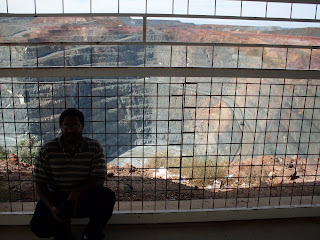
The gold mine, owned and operated by Barrick Gold Corporation and Newmont mining Corporation, produces around 28 tonnes of gold annually. Okay, with 28 tonnes of gold annually, no wonder some of these blue collar workers earn more than AUD$200,000 annually and buy those posh cars that I see so often. Just yesterday, on the TodayTonight show, they showed a young miner who was less than 25 years old, with his brand new car. He completed Tafe college and now worked in one of the many mines in WA. He was saying that the money was good but not everyone would like the hours put into mine work. The mine employs just over 500 people who work shift hours.


Anyway, it was the first time I had seen a open cut mine and was totally in awe of its size. Its length was about 35 rugby league fields put end to end and its width was about 1.5 km. They had these huge yellow dump trucks going down the sides of the mine until they reached the base, some 400meters deep. Then when they are filled with earth and rocks, they move ever so slowly up the winding staircase of makeshift two-lane road to the surface. The mine is so deep and so large that many say that it can be seen from space. I bet up in space it looks like a scar on someones body!
Wheatbelt of WA
Looking at flat land stretching for miles as far as the eye could see and writing about it might seem abit excessive. However coming from a country like PNG where almost everywhere you look is a hill or a mountain nearby, i would have to say that seeing flat land such that of the wheat fields in WA is as a bliss as seeing the sun set each afternoon.


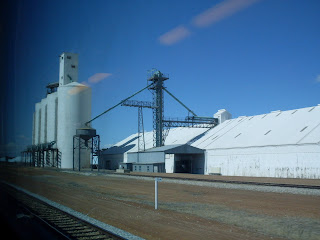
The farm houses look nothing like those on McLeod's Daughters television series on Channel Nine (hahahaha). Instead, they are hot, tough and people really do struggle especially in times of bushfires. There are dogs and sheeps here and there. Farm hands and the odd Toyoto Landcruiser. Along the train route, I can see huge white silos used for grain storage. People from Merriden area often say that huge silos are the largest of their kind in the Southern Hemisphere. I think there must be truth in them since each silo can hold up to 60,000 tonnes of grain. There is a good road system that runs along the towns and most people have to have cars and trucks becasue of the nature of the work and place. The days are hot and dry but are as cold as a freezer during the nights.


The Wheatbelt is a huge area and I have not seen most of the places. There is even a place called Wave Rock which is a rocks shaped as towering waves that i would like to visit soon. These pictures show just the places along the TransWA route that I got to see.
I travelled by train from Perth to Kalgoorlie, a distance of around 600km (370 miles) east of Perth and it took about four hours to reach Kalgoorlie station. TransWA runs the passenger service for about AUD $45 for a student fare one way. The area from the Perth metro right up north into the midwest and east to Esperance and the goldfields is called the 'West Australian Wheatbelt'.
It has a land area of over 150,000 km2 and has a population of between 69,000 to 72,000 all spread along this vast area on farms, small towns and outstations. About 15,000 people live in rural towns such as Narembeen, Merriden, Northham and some others more whle the rest live on family farms.
The region is most used for agricuture and it produced two-thirds of WA's wheat production, half of the state's wool production and half of the state's lamb, oranges, honey, watermelon and other agricultural products.


The farm houses look nothing like those on McLeod's Daughters television series on Channel Nine (hahahaha). Instead, they are hot, tough and people really do struggle especially in times of bushfires. There are dogs and sheeps here and there. Farm hands and the odd Toyoto Landcruiser. Along the train route, I can see huge white silos used for grain storage. People from Merriden area often say that huge silos are the largest of their kind in the Southern Hemisphere. I think there must be truth in them since each silo can hold up to 60,000 tonnes of grain. There is a good road system that runs along the towns and most people have to have cars and trucks becasue of the nature of the work and place. The days are hot and dry but are as cold as a freezer during the nights.


WA's golden outback is renowned for its rolling pastures where wheat grow and sheep graze. It is also home to simmering hot salt lakes. One of the problems these rural farmlands face is the problem of salinity. Roads, pathways and plant life have been killed by rising saline ground water. In some places it has formed huge salt lakes that stretch for miles on end.


The Wheatbelt is a huge area and I have not seen most of the places. There is even a place called Wave Rock which is a rocks shaped as towering waves that i would like to visit soon. These pictures show just the places along the TransWA route that I got to see.
Subscribe to:
Posts (Atom)